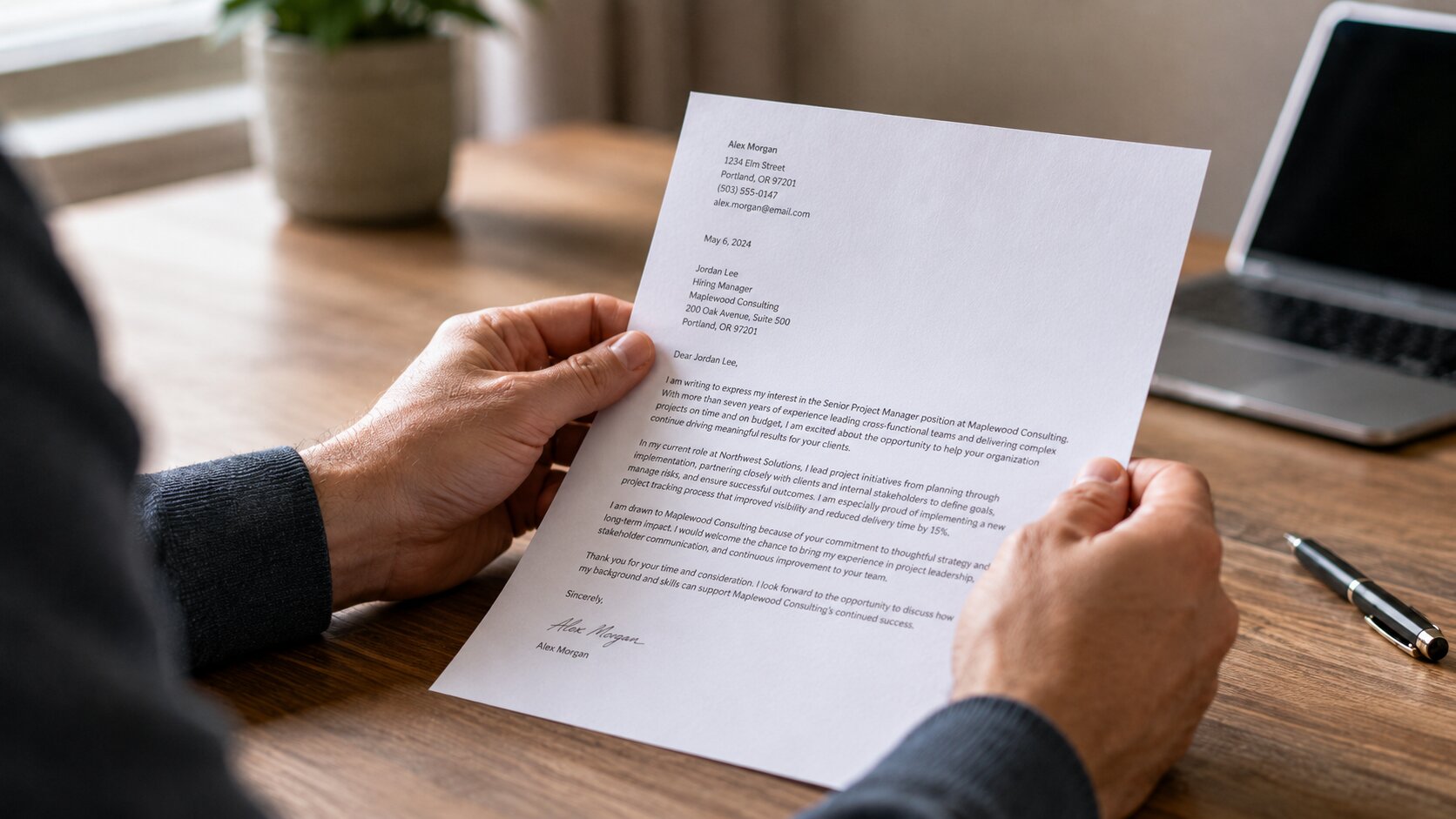
TL;DR: Most cover letters get skipped. A smaller share — maybe a third — actually get read. Whether yours lands in that third has almost nothing to do with how well it’s written and almost everything to do with the situation you’re applying in. Here are the three situations where a cover letter still decides the interview, and the structure that survives the skim when it matters.
You already know the polite answer. “Yes, always include a cover letter. It shows effort and lets you tell your story.” Career coaches say it. ATS guides say it. Your aunt who hires people at her company says it.
You also know what actually happens. You spend ninety minutes crafting one. You paste it into the third box on a five-box form. You never hear back. The next day you submit a different application with no cover letter requested and get a callback that afternoon.
So which is it? Are cover letters dead, or are you sabotaging yourself by skipping them?
The honest answer is more useful than either: cover letters mostly don’t get read, but the ones that do get read are read carefully. Whether yours falls into the second bucket isn’t about the writing. It’s about the situation.
The “Do They Read It” Question Has a Two-Part Answer
Industry surveys on cover letters tell a strange split-screen story. When you ask recruiters whether cover letters matter, the answer skews high — somewhere in the 70-80% range say they’re at least useful. When you ask whether they actually open them on a given application, the number collapses. Most pass-through surveys put it under 40%, often closer to a quarter.
Both numbers are real. They describe two different moments.
The first moment is screening — a recruiter or coordinator working through a stack of inbound applications under time pressure. At that stage, the cover letter is a tab they don’t open. The resume is doing all the work. (Eight glances, six seconds, and they’ve decided.)
The second moment is after the resume has earned a second look. Now the cover letter becomes a tiebreaker. It answers the question the resume can’t: why this role. At this stage, the cover letter doesn’t just get read — it gets weighted.
So the question “do recruiters read cover letters” has a clean answer. Not at first. Sometimes after. The leverage is in the second moment, not the first.
The Three Situations Where the Cover Letter Decides
If you’re applying to a role where your resume is an obvious fit — same title, same industry, recent relevant experience — the cover letter is almost decoration. The resume already made the argument. A generic cover letter doesn’t add. A great one barely does either.
The cover letter earns its keep in exactly three situations.
1. You came in through a referral or a warm intro
A referral lands your resume on top of the stack, but it doesn’t tell the hiring manager anything about fit. That’s the cover letter’s job.
When someone reads your application because a person they trust passed it on, they’re predisposed to say yes. They’re looking for the small reason that confirms the referral was right. A two-paragraph note — here’s what I’d bring, here’s why this team specifically — converts well-disposed attention into a phone screen.
The version that doesn’t work: copying the same generic CL you sent to forty other companies and slapping the referrer’s name at the top. The version that does: writing about the company’s actual situation as if you’ve been thinking about it. Because if you have a real referral, you probably have.
2. You’re making a career transition
If your resume shows ten years in marketing and you’re applying for a product role, the resume opens with a contradiction the reader has to resolve. They’re going to do it in three seconds — either they decide it’s a strong pivot or they pass. The cover letter is your only chance to steer that decision.
This is the use case where cover letters carry the most weight. Surveys of recruiters who hire across functions consistently rank “career changer” as the situation where the cover letter most influences their decision.
A career-transition cover letter has one job: collapse the perceived distance. Name the function you’re moving into. Name three things from your current background that translate cleanly. Don’t apologize, don’t over-explain. (More on positioning the transition itself.)
3. There’s a gap, a layoff, or something the resume can’t explain
If you have a two-year gap, were laid off in a public round of cuts, or are coming back to work after caregiving or illness — the resume can structure it, but it can’t narrate it. A short, unfussy paragraph that names what happened, what you did with the time, and what you’re optimizing for now does more than any clever bullet rewrite.
The mistake is treating the gap like a confession. The fix is treating it like context. “I took 2024 to support a family medical situation. I used the back half of that year to ship two contract projects for X and Y. I’m now looking for a full-time role where Z.” That’s it. No drama, no apology, no padding.
The cover letter doesn’t have to do all the work. (The resume itself can shape how a gap reads.) But for hiring managers who weren’t going to look past the gap, the cover letter is what makes them.
What About Everyone Else?
For roles where you’re an obvious fit and applying cold, the cover letter is mostly a tax. You should still write one — many ATS systems flag missing CLs as incomplete applications, and a small share of hiring managers do read them — but you should write it in fifteen minutes, not ninety.
The opportunity cost matters more than the cover letter itself. Ninety minutes spent crafting one perfect cover letter for one role is ninety minutes you didn’t spend tailoring six resumes to six roles. (Tailoring is where the leverage actually is.) The tradeoff is real, and most people get it backwards.
The honest budget:
- Referrals, transitions, gap situations: invest. Write the good version.
- Strong-fit cold applications: write the fast version. Three short paragraphs, role-specific opener, done.
- Optional CL field: skip it if you’re applying broadly and tailoring resumes instead.
What “Read Carefully” Actually Means
When a cover letter does get read, the reader is doing something specific. They’re looking for three things, in this order:
One: a reason this role, not just any role. The opener is the entire test. “I am writing to express my interest in the Senior Analyst position” fails it before the second sentence. “I’ve spent the last four years doing exactly the kind of customer-research-into-product-spec work your team is hiring for, and I noticed you’re rebuilding the onboarding flow this year” passes it.
The opening sentence is where 80% of cover letters die. It’s the only sentence guaranteed to be read.
Two: evidence that the resume’s strongest claim is real. The reader has the resume open. They’ve already seen the punchline. The cover letter is their chance to test it. If your resume says “led $40M product launch,” the cover letter is where you say what your actual role was, who else was involved, and what went wrong. Specifics here are credibility. Repeating the resume verbatim is the opposite.
Three: signal that you understand the company’s situation. Not “I love your mission” — every cover letter says that. Something narrower: a recent product change, a hiring pattern that suggests where the team is going, a specific challenge in their market. One sentence is enough. It’s the cheapest, most reliable way to prove you’re not running a copy-paste campaign.
Three paragraphs. One opener that names why this role, one middle paragraph that puts evidence behind your resume’s strongest claim, one short close that signals you’ve actually thought about the company.
That’s the format. Everything else is filler.
The AI Section You Knew Was Coming
Here’s where things got harder in the last two years. Anyone can now generate a polished cover letter in fifteen seconds. The result: hiring managers are reading the same five openings over and over. “I was excited to come across the [role] position at [company].” “Your commitment to innovation aligns with my passion for…” The phrasing varies. The cadence doesn’t.
The data here is converging with what we’ve seen on resumes. AI screening tools prefer AI-written content by a wide margin, but human readers are calibrating fast in the other direction — they can spot the cadence and they skim past it. The polish that used to be a signal is now noise.
This sounds like an argument against using AI for cover letters. It isn’t. It’s an argument against using AI to write the cover letter from scratch.
The version that works is the same one that works for resumes. You write the rough version — bad sentences, real specifics, your own voice. You let AI tighten it, flag where you’re hedging, point out the opener that reads as boilerplate. The AI is a coach on your draft, not a ghostwriter. (The full pattern, with examples.)
What hiring managers can still tell, even at three seconds, is whether you’ve been thinking about this role. A cover letter that ChatGPT wrote without your input shows it. A cover letter that you drafted in five rough sentences and then refined shows that too — in the better direction.
When to Skip the Cover Letter Entirely
Three situations where skipping is fine and may even help:
- The form has no cover letter field. Don’t paste it into the “additional notes” box. That box is for the recruiter’s notes, not yours.
- You’re applying through a recruiter who explicitly said “just send the resume.” They mean it. Sending an unrequested CL signals you don’t listen to instructions.
- The role is a clear match and the company gets thousands of applicants. The cover letter isn’t going to be read. Save the energy for a strong resume tailored to the JD.
The hidden cost of cover letters isn’t the time per letter — it’s the time you take away from the things that actually move callbacks: tailoring, networking, follow-up. (What follow-up actually looks like.)
The Real Bar
The polite answer to “do recruiters read cover letters in 2026” is yes. The cynical answer is no. The honest answer is the one that’s actually useful: they read them when they have a reason to, and you can predict the reasons.
If you’re being referred, if you’re pivoting, if you’re explaining a gap — write the good version. Take the time. The cover letter is doing real work in those situations and a strong one converts.
If you’re applying broadly to roles that are an obvious fit, write the fast version. Don’t skip it; don’t pour your weekend into it. The leverage is in your resume and your targeting, not in your cover letter.
Either way, the trap is the same: writing the same boilerplate opener every other applicant is writing. “I am writing to express my interest” was already weak in 2019. In 2026 it’s the sentence that confirms the cover letter wasn’t worth reading.
Need to write a cover letter that doesn’t sound like every other cover letter? Resumes Coach generates one against the actual job description in seconds — Professional, Conversational, or Custom tone — and you can refine it line by line instead of starting from a blank page. Try it →