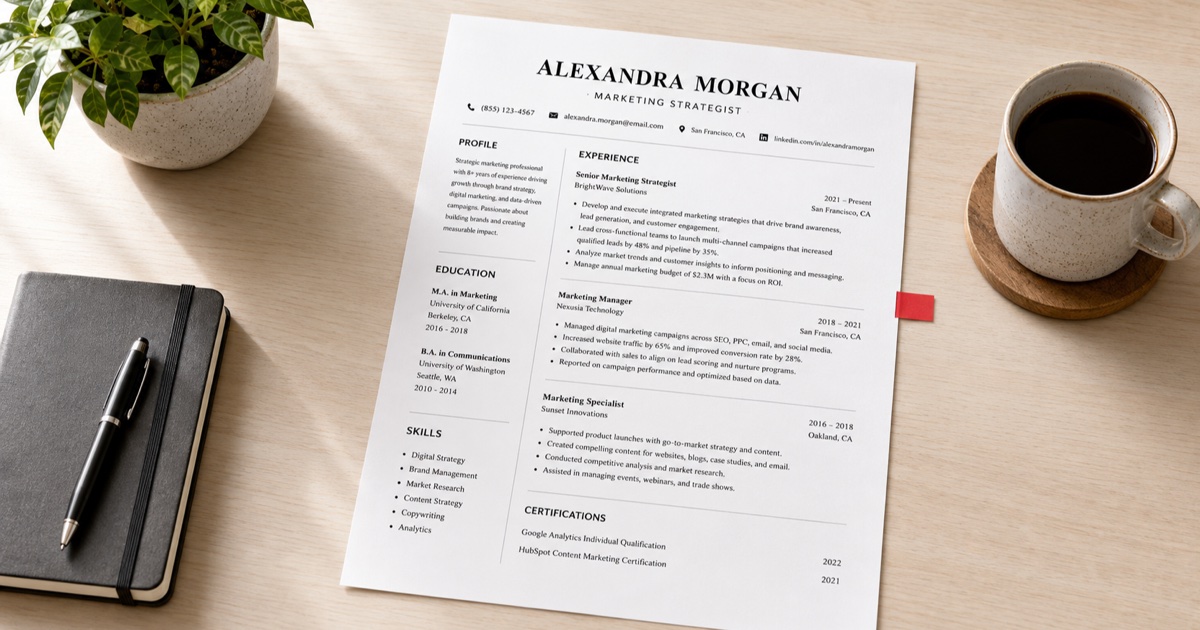
For years, a flawless resume was the goal. Clean formatting, tight bullets, every keyword from the job description accounted for. That was the signal of a serious candidate.
That signal is breaking. Forbes recently reported on the shift: recruiters are starting to treat the flawless, machine-perfect resume as a warning sign rather than a strength. The logic is simple. When most applicants can generate a perfectly formatted, keyword matched resume in about thirty seconds, “perfect” stops meaning “excellent.” It starts meaning “everyone.” And a growing number of recruiters say the too polished resume now reads as a tell: a document written by a chatbot rather than by a person who actually did the work.
So the bar did not disappear. It moved. Here is where it went, and how to land on the right side of it.
Why does a “perfect” resume now raise suspicion?
A recruiter skims for a few seconds and forms a gut read. What used to earn a nod, smooth phrasing and full keyword coverage, is now the exact thing that can trip the alarm, because it is what a generic AI draft produces by default.
Think about what a raw chatbot optimizes for when you paste in a job description and ask for a resume. It mirrors the posting almost word for word. It reaches for confident, rounded phrasing. It fills every section. What it does not do, unless you make it, is know which of your accomplishments actually mattered, or why. So it hands you polish with no proof underneath.
Recruiters have learned to feel that gap. The resume sounds impressive and says nothing they can verify.
What are they actually reacting to?
It is worth being precise, because the reaction is not really “this used AI.” Plenty of strong resumes were touched by AI somewhere. The reaction is to a specific texture:
Achievements with no numbers. “Improved efficiency,” “drove results,” “collaborated cross functionally.” True of almost anyone, provable by no one.
Language that mirrors the job posting too closely. When your bullets read like the description reflected back, it looks like matching, not doing.
A suspiciously even tone. Every line equally confident, equally smooth, with none of the specific, slightly uneven detail that comes from a real project you remember.
None of those are AI problems. They are grounding problems. The resume floats above your actual experience instead of standing on it.
The fix is not to make it worse
The wrong lesson here is “add a typo, rough it up, sound less capable.” That is just a different kind of fake.
The real fix is specificity. The thing a generic draft cannot invent, and the thing recruiters lean toward, is the concrete, verifiable detail of what you actually did.
Compare these two:
Improved user retention through data driven initiatives.
Cut first week churn from 22 percent to 15 percent by rebuilding the onboarding flow, over one quarter.
The second one is not fancier. It is grounded. It names a number, a mechanism, and a timeframe, which is exactly the shape of a claim a recruiter can picture and trust. It also happens to be the shape a chatbot cannot produce for you, because only you know that story.
That is the whole game now. Not less polish. More proof.
How do you know if your resume reads generic?
Run your bullets through a quick self test:
- Could a stranger have written this line about themselves? If yes, it is too generic. Anchor it to something only you did.
- Is there a number, a name, or a specific outcome in it? If a bullet has none, it is a candidate for a rewrite.
- Does it echo the job posting, or does it describe your work? Mirroring reads as matching. Describing reads as doing.
If most of your resume passes, you are in good shape. If it does not, that is not a reason to panic, it is the highest leverage editing you can do this week.
Where Resumes Coach fits
This is the exact problem we built for. With a free resume check, we read your resume the way a recruiter would and flag the lines that sound generic, the achievements missing proof, and the sections that mirror the posting instead of describing your work. You get back a clear Resumes Coach Score and a specific list of what is pulling it down.
Then, when you tailor a resume to a role, our guided rewrites do the part a raw chatbot skips. They push each weak bullet toward a grounded, specific version rooted in what you actually did, not a smoother restatement of the job description. AI can absolutely help you write a resume. The difference is whether it hands you polish or helps you show proof.
Perfect is not the target anymore. Real is. And real, it turns out, is a lot easier to write when something is pointing you straight at the lines that are not.
Want to see how yours reads? Run your resume through a free check and see the lines a recruiter would flag in the first ten seconds.