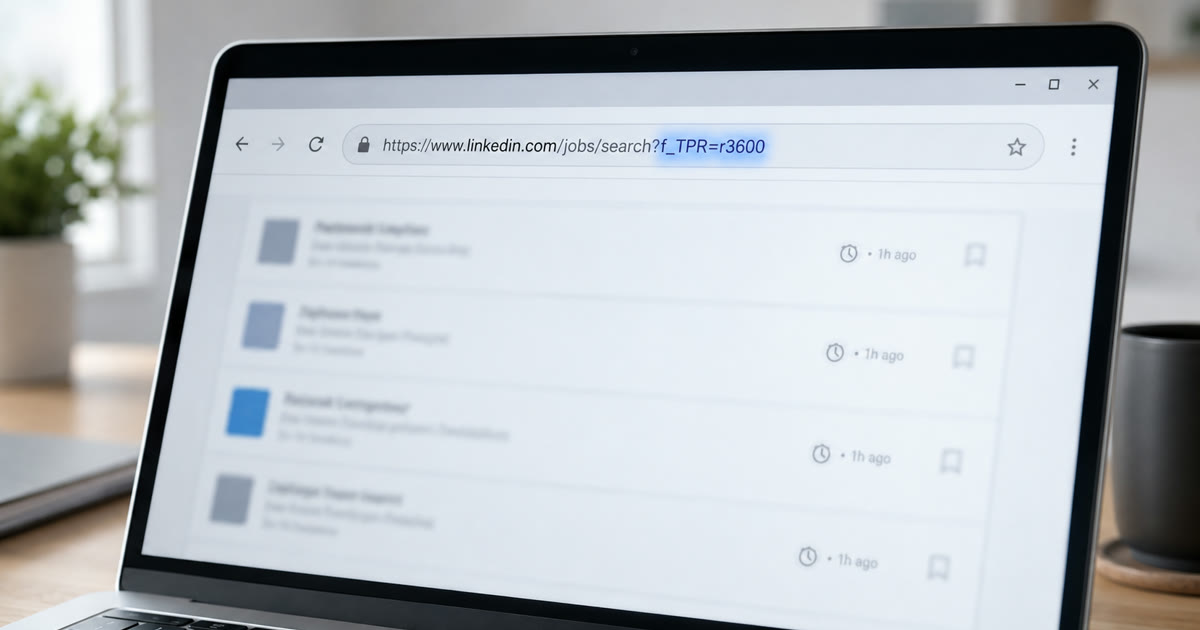
LinkedIn lets you find jobs posted in the last hour, not just the last 24, by editing one number in the search URL. Here is the exact move, and then a warning that matters more than the trick.
The trick: narrow your LinkedIn search to the last hour
LinkedIn’s job search hides a dial most people never touch. It lives in the URL, and it has been making the rounds in the r/jobsearchhacks community for a reason.
Run a normal job search. Add the “Past 24 hours” option from the Date posted filter at the top of the results. Now look at your browser’s address bar. Somewhere in that long string you will see a parameter that looks like this:
f_TPR=r86400
That r86400 is a Time Posted Range in seconds. 86400 is the number of seconds in 24 hours. The filter is really just a countdown window, and you can hand-edit the number to make it smaller.
Want only jobs posted in the last two hours? Change it to 7200. Last hour? 3600.
f_TPR=r86400 is the last 24 hours f_TPR=r7200 is the last 2 hours f_TPR=r3600 is the last hour
Edit the number, press Enter, and the results reload showing only the freshest postings. You are now looking at roles before most applicants even know they exist.
One practical note. In a smaller market or a niche role, the last hour can come back nearly empty. If it does, widen the window back out (r21600 for six hours, or back to r86400) instead of assuming the trick is broken. It is a dial, so turn it to where the results actually live.
The honest caveat
LinkedIn changes its query parameters from time to time. The exact name or format could shift after you read this. If f_TPR stops working one day, do not treat that as a dead end.
The principle survives the parameter. The move is always the same: narrow your window so you are applying while a posting is still fresh, not days later when it is buried under newer applicants. The URL is just the current lever. If the lever changes, find the new one. The goal never changes, because timing changes who reads you.
Why fresh postings get a better read
How much freshness helps depends on the team. Plenty rank applicants by match score instead of arrival order, some review in scheduled batches, and a fair number of reqs sit untouched until a screening call is on the calendar. But a common pattern still rewards the early applicant. A posting goes live, the first resumes land within hours, and a fresh reviewer with an empty stack tends to read them closely. Later the stack is deep, the reviewer is skimming, and the search shifts toward reasons to cut.
Applying while a role is fresh puts you in front of someone who is still reading with attention, and that is an edge worth taking. We wrote about the broader version of this in timing your applications. Timing is a real edge. It is just not the whole game.
The catch: first in line, still cut
This is where being early stops helping, and starts hurting.
Speed only helps if your resume is built for that specific posting. Being first with a generic resume is not an advantage. It is just faster rejection. Picture it: you find a fresh role early, you are thrilled to beat the crowd, so you fire off the same resume you send to everything. It lands in the first batch, gets a careful read, and gets cut in seconds because it clearly was not written for this job. You spent your speed advantage on a resume that could not convert it.
We first saw this move making the rounds when a career coach on LinkedIn reshared the r/jobsearchhacks tip. Credit where it is due. But the sharpest thing on that whole thread was not the coach’s post, it was a comment underneath it. That comment made exactly this point: matching your experience to the right opportunity is what turns an application into progress. Not being fastest. Being fastest at the right thing.
Being early can earn a closer read while the reviewer’s attention is fresh. Whether you get hired still comes down to fit. You need both, in that order, because a fresh application only pays off when the resume behind it was built for the role.
Speed plus a tailored resume
So pair the freshness move with tailoring. When you land on a posting in that first hour, do not reflex-send. Take the ten minutes to align your resume to what the posting actually asks for: the exact title, the stack it names, the problems it says it needs solved, in the words it uses rather than the ones you happen to already have on the page.
This is not about stuffing keywords to trick a filter. It is that a resume genuinely built for the posting clears both gates between you and the interview. The automated one first: many systems rank applicants by how well they match the job, so a resume that speaks the posting’s own language surfaces near the top instead of sinking in the pile. Then the human one: the reviewer who opens your early application reads someone who is obviously a fit, not a generic profile they have to squint at. Being first only gets you into the batch. Being tailored is what carries you through the software’s ranking and past the recruiter’s skim. One base resume, then a focused per-role pass that swaps in the language and priorities of the posting in front of you. For how the parsing actually works, see how screening systems parse a resume.
The workflow that keeps it from slipping
Here is the failure mode. You find a great fresh role, you mean to tailor and apply, then a meeting eats your afternoon and by evening you cannot even find the posting again. The window closed and the advantage evaporated.
Speed only compounds if you capture the moment you find it. Three steps, in order:
Capture the posting the second you find it, before the tab closes. Tailor your resume to that specific role. Track it so nothing slips through the cracks.
Capture is the easiest step to skip, and skipping it is where fresh roles quietly leak away: the great posting you meant to come back to and never found again. So make capture a reflex. Our one-click job-capture bookmarklet grabs any posting the instant you find it, and our application tracker keeps every captured role in one place so nothing slips between finding it and applying. Capture with one, track with the other, and the fresh role you spotted this morning is still there, tailored and sent, before the batch fills up.
The one line to remember
The URL trick is real and it works today. Use it. But do not confuse being early with being done.
Being early, on its own, just gets you rejected sooner. At best it improves your odds of a close read while attention is high; fit is what survives it. The people who win the timing game capture fast, tailor to the exact posting, and let nothing slip.
Before you spend that speed advantage, it helps to know where your resume stands. Our free resume score gives you an honest read on what is working and what to fix, so the fresh roles you find are worth the fast application.